
Before We Call It Bullying, Let's Ask a Better Question: Are We Teaching Children the Social Skills They Need to Thrive?

Updated: Jul 25
The Social Skills Conversation Depicted in Toy Story 5

Children’s interactions today often get labeled quickly as bullying, but what if the real issue is something deeper? What if we are missing a crucial conversation about whether children are learning the social skills they need to succeed?
Toy Story 5 offers more than just nostalgia and entertainment...it subtly highlights the importance of social skills in childhood development.
This post explores how the film opens a door to a better conversation about how we prepare children for social challenges.
At the beginning of the film, Bonnie notices the twins from next door. She desperately wants to connect with them but freezes. Jessie intentionally rolls herself into the twins’ path so Bonnie has a reason to approach them. Bonnie retrieves Jessie, hides behind her, nervously waves Jessie’s arm, and says “Hellooo!” in an awkward voice instead of introducing herself. The twins exchange a confused look, giggle, and run into their house, leaving Bonnie embarrassed and alone. Pixar establishes from the very beginning that Bonnie isn’t being rejected because she’s mean or unlikeable. She’s struggling with social confidence and doesn’t yet possess the skills needed to initiate friendship.
That scene is fascinating because so many viewers immediately ask,
“Were the twins bullies?”
Perhaps.
But perhaps not.
What if they were simply children who didn’t know how to respond?
Imagine you’re eight years old. A child you’ve never met suddenly hides behind a doll, speaks through it in a different voice, avoids eye contact, and appears visibly uncomfortable. Most children, and even many adults, would not know how to interpret that behavior. Some laugh when they’re uncomfortable. Some walk away. Some become awkward themselves.
That doesn’t necessarily make them bullies.
It may simply reveal that they, too, lack social competence.
And maybe that’s the larger message Pixar is inviting us to consider.
Today’s children have fewer opportunities to develop authentic face-to-face social interaction. They spend less time knocking on neighbors’ doors, riding bikes together until sunset, inventing games, negotiating disagreements, reading facial expressions, resolving conflict, and learning the subtle give-and-take of friendship. Instead, many social experiences are filtered through screens, texts, gaming platforms, and social media. As a result, children may be entering real-world interactions without the practice needed to navigate uncomfortable moments with confidence. The film itself explores this broader tension between imaginative play, technology, and children’s growing reliance on digital connection.
As educators and parents, we often ask:
“Who hurt my child?”
Perhaps we should also ask:
“Have I intentionally prepared my child for the inevitable social challenges they will encounter?”
Life guarantees uncomfortable moments.
Life guarantees rejection.
Life guarantees misunderstandings.
Life guarantees disappointment.
The answer cannot be eliminating every uncomfortable interaction.
The answer is strengthening children so they can navigate those interactions successfully.
This is where the 7 Cs of Resilience become so powerful.
Instead of focusing exclusively on changing everyone around our children, we should also be asking how we are strengthening the child within.
Are we building:
Competence, so children develop genuine social skills through practice?
Confidence, so one uncomfortable interaction doesn’t define their self-worth?
Connection, so they experience healthy, supportive relationships?
Character, so they treat others with kindness, even when differences exist?
Contribution, so they recognize they have value to offer others?
Coping, so embarrassment doesn’t become avoidance?
Control, so they learn they cannot control others’ reactions, only their own responses?
Bonnie didn’t need perfect peers.
Bonnie needed greater confidence approaching peers.
Likewise, the twins didn’t necessarily need negative consequence or response to their behavior.
The twins (like many children-and adults!) may have needed guidance in recognizing when another child is nervous, shy, socially awkward, or simply struggling to connect.
This is not about blaming Bonnie.
Nor is it about blaming the twins.
It is about recognizing that many of today’s children are entering childhood with fewer opportunities to develop the social competence previous generations acquired naturally through unstructured play and repeated face-to-face interactions.
Perhaps the most important question isn’t:
“Who is hurting my child?”
Perhaps it’s:
“How do we raise children who are socially competent enough to approach others with confidence, and compassionate enough to respond with empathy when someone else struggles to do the same?”
That shift in thinking moves us beyond blame and toward resilience.
Because resilient children are not those who never experience discomfort, rejection, or misunderstanding. Resilient children are individuals who possess the confidence, competence, emotional regulation, and coping skills to recover, try again, and continue building meaningful relationships - even when social interactions don’t go as planned.
That may be one of the most important lessons depicted in Toy Story 5.

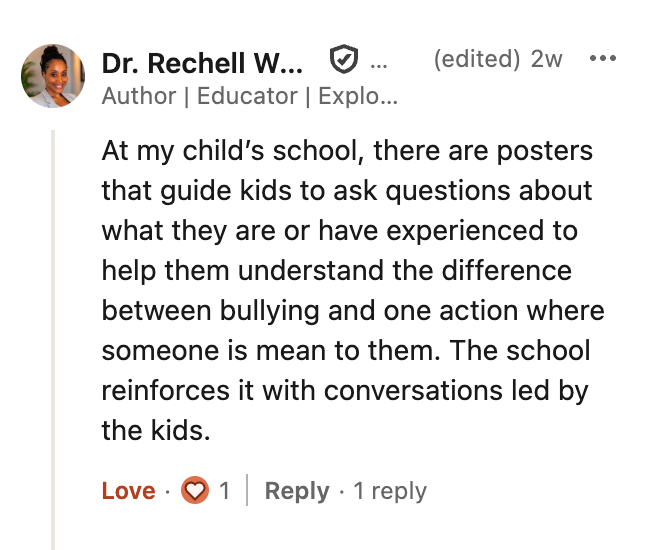


At my child's school, there are posters that guide kids to ask questions about what they are or have experienced to help them understand the difference between bullying and one action where someone is mean to them. The school reinforces it with conversations led by the kids.