
Stop Calling It Boredom

You're Disconnected and Disengaged from Your Life

In a recent episode of The Oprah Podcast, Arthur C. Brooks offers a powerful and timely insight into what many are calling an “age of emptiness.”
Despite unprecedented levels of success, access, and convenience, people are reporting feeling more meaningless, anxious, and disconnected than ever before.
At first glance, some might describe this as boredom.
But it is not boredom.
It is something far more significant.
We are not bored with life.
We are disconnected from it.
And at the core of this disconnection is something we are not talking about enough, the human need to be needed. Every person requires a role, a function, a purpose that allows them to contribute in meaningful ways. Without that, life does not feel engaging, it feels empty.
The Real Problem: Disconnection Disguised as Boredom

Brooks explains that many people feel a sense of emptiness, often turning to constant distraction to cope. The average person checks their phone nearly 205 times a day, living in what he describes as a “doom loop” of behaviors that temporarily soothe, but ultimately deepen dissatisfaction.
This is where the misunderstanding lies.
What we are witnessing is not a lack of stimulation.It is a lack of true connection and meaningful engagement.
People today are increasingly:
Disconnected from the real world
Disengaged from authentic human interaction
Yet deeply connected and highly engaged in the virtual world of social media
And that virtual world, while fast, stimulating, and rewarding in the short term, is often:
Superficial
Shallow
And ultimately, toxic when overconsumed
It gives the illusion of connection without the responsibility, contribution, or purpose that real life requires. And without those elements, the fundamental human need to be needed is never fulfilled.
The Three Environmental Toxins

This aligns directly with what I have identified as three growing environmental toxins impacting our children and ourselves:
Isolating technologies
Dopamine-driven habits
Narratives of doom
These forces are not just influencing behavior.
They are shaping identity, attention, relationships, and resilience.
They keep individuals in cycles of consumption rather than contribution, distraction rather than reflection, and comfort rather than growth.
And most critically, they strip away opportunities for individuals to have a meaningful role, to be responsible, to be counted on, to be needed. https://www.josephinehunt.com/leadership-philophy
Happiness Is Not Enough

One of the most important distinctions Brooks makes is that happiness is not simply about feeling good.
He breaks it into three components:
Enjoyment
Satisfaction
Meaning
And here is the critical insight:
You can experience enjoyment and achievement, yet still feel empty without meaning.
Because enjoyment and satisfaction can exist without contribution, but meaning cannot. Meaning requires that we matter, that we serve a purpose, that we are needed in some way beyond ourselves.
Meaning: The Missing Piece

Brooks defines meaning through three essential dimensions:
Coherence, understanding why things happen
Purpose, understanding why you are doing what you are doing
Significance, knowing that you matter to others
This aligns seamlessly with the work of building mental wealth and resilience.
Because meaning is not something we passively receive.
It is something we actively construct through challenge, reflection, and connection.
And at the heart of all three is the same truth: people need to feel that they are needed. That their presence matters, that their contribution has value, and that their role in the world is meaningful.
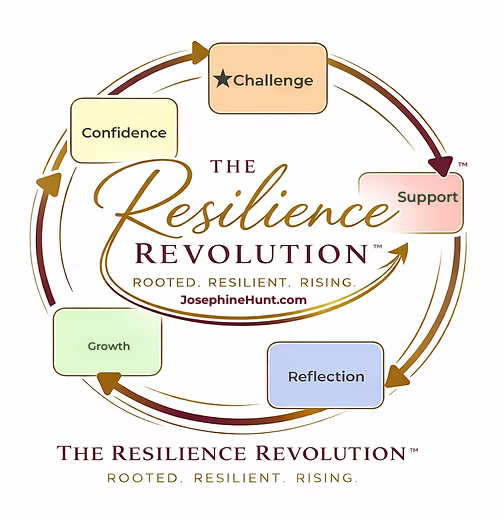
The Resilience Loop™ and Meaning

This is where The Resilience Loop™ becomes essential:
Challenge
Support
Reflection
Growth
Confidence
When individuals are shielded from challenge or constantly distracted from reflection, the loop breaks.
Without reflection, there is no coherence.
Without challenge, there is no purpose.
Without connection, there is no significance.
And without those three elements, meaning cannot form.
Without opportunities to contribute and to be needed, the loop weakens even further. Growth becomes limited, confidence becomes fragile, and resilience becomes underdeveloped.

The Doom Loop™ vs. The Resilience Loop™
Brooks describes the “doom loop” as behaviors that provide short-term relief but long-term harm.
Scrolling
Avoidance
Overconsumption
These mirror the very toxins we see daily.
In contrast, The Resilience Loop™ interrupts that cycle.
It replaces avoidance with engagement
Distraction with reflection
Consumption with contribution
And in doing so, it restores something essential, the opportunity to live a life of purpose, to take on responsibility, and to feel needed in real and meaningful ways.
A Critical Reframe for Our Time
We must stop saying that people, especially children, are bored.
They are not bored.
They are:
Disconnected from meaningful experiences
Disengaged from real-world challenges
Overstimulated by artificial inputs
Underdeveloped in resilience
They are living in environments where connection is simulated, not experienced.
And where contribution is optional, rather than expected.
Without responsibility, without challenge, without real engagement, individuals are left without a function, without a role, and without a sense that they are needed.
The Truth About Meaning

Brooks leaves us with two defining questions:
Why am I alive?
What would I be willing to die for?
These are not questions that can be answered through scrolling, shortcuts, or comfort.
They must be lived.
And they are built through:
Challenge
Connection
Contribution
They are built when individuals are given opportunities to show up, to take responsibility, to struggle, to grow, and to matter.
The Takeaway
We are not facing a crisis of boredom.
We are facing a crisis of disconnection.
Overprotect
ion combined with overstimulation is not creating safety. It is creating fragility.
Constant input without reflection is not creating knowledge. It is preventing meaning.
And meaning is the foundation of both mental wealth and resilience.
A meaningful life is not one of constant ease, it is one of function, purpose, responsibility, and contribution. It is a life where individuals know they are needed.
The Call Forward

If we want to raise resilient children and develop mentally well communities, we must:
Reduce the influence of isolating technologies
Interrupt dopamine-driven patterns
Challenge narratives of doom
Reintroduce real-world engagement
Create space for reflection
Prioritize human connection
And just as importantly, we must create environments where individuals are expected to contribute, to take on responsibility, and to play a meaningful role.
Because meaning is not found in ease.
It is built through challenge, strengthened through connection, and realized through contribution.
It is sustained through purpose, responsibility, and the deeply human need to be needed.
And that is the work of The Resilience Revolution™.


Comments